
Attention, Devotion, and Life
our only possession is our attention and our only power where we direct it

“You are not required to believe what I tell you but to think it.” - R. Steiner1
George Washington Carver famously said, “Anything will give up its secrets if you love it enough. Not only have I found that when I talk to the little flower or little peanut it will give up its secrets, but I have found that when I silently commune with people they give up their secrets also—if you love them enough.”2
Dr. Carver himself constructed an inner sanctum — “God’s Little Workshop” as it was called.3 Into that contemplative space, Dr. Carver would take a plant and sit with it alone, until it communicated its secrets. While his external accomplishments are often praised, Carver’s spiritual life was an inseparable source of his insights, and we would do well to emulate him. The revelations of the Queen of Nature are virtually impossible to receive without undivided attention, without setting aside our own bodily comfort or discomfort, and sitting with just one thing.
When we devote our attention toward a particular object with noble qualities, our soul’s life takes on corresponding colors:
“Shades of blue appear in soul-moods full of devotion. The more a man places his self in the service of a cause, the more pronounced become the blue shades. In this class also one finds two quite different kinds of people. There are natures who are not in the habit of exerting their power of thought — passive souls who, as it were, have nothing to throw into the streams of events in the world but their good nature. Their aura glimmers with beautiful blue. This is also the appearance of many religious and devotional natures…. It is the peculiarity of the active souls in contrast to the passive, that their blue saturates itself from within with bright shades of color.”4
When Steiner says “colors,” he is describing something akin to — if you will forgive the analogy — the neurological phenomenon of synesthesia, wherein one sensory stimulus produces the effects of another (e.g., someone who hears music and sees it also as colors). Or imagine, if you will, how a particular wine’s aroma can evoke the mood of a dark forest grove, or a sunny open field, or a rocky desert — or if it’s a bad wine, perhaps even some moldy janitor’s closet. Steiner is describing how specific moods in others elicit in him the same feeling as particular shapes and colors do in the external world.5 Because we can only perceive that which we can resist, this does not mean being overwhelmed by any particular feeling, but, with Rilke, “Let everything happen to you: beauty and terror. Just keep going. No feeling is final.”6
A devotional mood — as a soul “color” blue — takes on forms more or less articulate depending on the concentration of the devotee. Undirected, wishy-washy devotional feeling pointing in no particular direction is not strong enough to stimulate focused, attentive effort and appears like a fuzzy cloud:

When we devote our attention to a particular phenomenon without distraction, it begins to disclose its meaning. We cannot hear it if we are talking. We cannot hear it if we are busy thinking about something else. We cannot hear it if we are eating. We cannot hear it if we are listening to music. It is impossible to feel what the plant would evoke in us if our attention is diluted with anything else. This is why I never work with music blaring; you can see how no one gets much done when they are busy talking.7 Merely oscillating one’s attention from one activity to another — from talking to working — spends a full third of their total time doing nothing but shifting gears: the conversation itself is cheapened, and the work is lessened; the only winner is the demon of distraction. And a third of one’s life is squandered.
We cannot listen to two conversations at once. At most, we will get a cloudy admixture, and everything that should be bright floral colors will be nothing but degrees of muddiness. To recognize something fully, our own private sensations must be suspended so that the thing itself can speak its meaning to us as a kind of “objective” feeling. As Thoreau writes, “A fact stated barely is dry. It must be the vehicle of some humanity in order to interest us.… It must be warm, moist, incarnated,—have been breathed on at least. A man has not seen a thing who has not felt it.”8 Dullness is first and foremost a failure to notice, which is first a failure to feel, because what is not felt and thus noticed never becomes a living memory. Whether we are drugging ourselves with opiates, music, or social media, when we fail to feel what is around us — because we are busy feeling something else — much of life’s valuable lessons slip by completely unnoticed. The same thing happens with plants:
“Even as I, a human being, can pass a dull fellow by and he will not notice me, so too all that is in the soil and above it will pass a dull plant by, and the plant will fail to sense it; will not, therefore, enlist it in the service of its growth. But if the plant is thus finely permeated and vitalised with silicic acid, it will grow sensitive to all things, and will draw to itself all that it needs.”9
Simone Weil famously said, “Attention is the rarest and purest form of generosity.”10 The opposite of any true statement is also true: distraction is the commonest and crudest form of selfishness. When we are too preoccupied with our own private likes and dislikes, we cannot be bothered to feel the meaning of other beings. As Shams Tabrīzī says, “The salaat can be made up later, but one can’t make up lack of presence.”11

When we grace a plant — or anything else — with undivided pointed attention, the spiritual world responds in kind. Nietzsche, whose expertise was the astral world, articulated this splendidly: “when you gaze long into an abyss, the abyss also gazes into you.”12 This is what St. John of the Cross called the “dark night of the soul,” which is so often confused as a sort of psychological depression; instead, he says, “for the intellect faith is also like a dark night.”13 The intellect by itself is “colorblind” to anything that might threaten its supremacy, while humble intuition — the organ of perception sometimes called faith — perceives forms the intellect cannot understand except by analogy.
The breakthrough into the domain beyond the mere intellect is the mystic’s entry into what another mystic calls the cloud of unknowing. The intellect has absolutely no rights in those spiritual meadows except for our gleaning. Our intellect can only catch what has “fallen” from the spiritual world, like grains of wheat left behind after the main harvest that happens overhead.

The intellect, when severed from the wellsprings of revelation, has only its concepts and its grasping belief — and rigid identity with them. Intuition, by contrast, is a kind of spiritual vision that can glimpse beyond the edges of beliefs and realize there is always more to know than I can ever know — even to the point that everything I believe I know is completely undermined or totally reframed. As St. Thomas Aquinas put it, “Everything that I have written seems to me straw in comparison with the things that I have seen and that have been revealed to me.”14 This is the experience of the spiritual realm beyond the intellect. As the straw of barley grows until it flowers and produces grains, the intellect, at its best, can bring us to a threshold it cannot cross.
What Steiner called “intellectualism” does not mean intelligence is bad, or even that erudition is harmful — Steiner was a prolific reader — but rather that the intellect deprived of intuition easily tends towards dead thinking: an inability to perceive anything but amalgamations of information, a blindness to wholeness.
This is what it means when people say, “Knowledge puffeth up, but charity edifieth.”15 The more one imagines one knows, the prouder one becomes, and pride leads to more serious errors, as there is no spiritual progress except growth in humility. “For every one step that you take in the pursuit of the hidden knowledge, take three steps in the perfecting of your own character.”16 A plant needs water and light: earthly and celestial streams of nourishment. To attend to something with caritas — with love — is what nourishes and mitigates the dangers of cold, unfelt knowledge. As Steiner says, “Free thoughts must activate the will, then is the human being free.”17
These days, people often imagine they can “teach” what they only just learned about yesterday. Unfortunately, this assumes that teaching is merely the conveyance of ones and zeros of information previously received. It imagines that learning is a form of “data transfer.” This is absolutely not true. An infant cannot “share” the milk it absorbs from its mother or by so doing imagine itself to be a mother. A student cannot “teach” what he just received as education from the teacher. As Alan Chadwick would say about plants, at first they take. Steiner would put it slightly differently, saying that “all plant-growth has this slightly parasitic quality.”18 This is identical to a young child, who at first can only absorb: “The child is wholly sense-organ.”19 In terms of the three gunas, everyone has an element of tamas, though it should be reduced to an absolute minimum with maturity.
An undeveloped plant cannot give anything until it is properly established, without sacrificing its own growth. The plant must be nurtured “in its growth, made a conservatoire, and deposited, and held, and [say], ‘I will give more than I’ve taken in this world.’”20 This is why a young plant must be watered, mulched, fed compost, pruned — for years — until it has the power to generate more fertility than it consumes. As Wangari Maathai said, “Until you dig a hole, you plant a tree, you water it and make it survive, you haven’t done a thing. You are just talking.”21 I’ve learned this the hard way. It is no virtue to plant a tree and abandon it, any more than to impregnate a woman and discard her. I planted countless trees in ignorance and let countless trees perish. Late in life, I try to tend what I plant rightly. People imagine themselves virtuous for sticking trees in the ground and neglecting them so long that they all perish — or survive by chance. Anyone can plant a sapling; few people have the devotion to tend it through childhood and into a self-sufficient tree for a decade.
If an undeveloped student tries to “give away” the resources he has only just received, that would be like a newly planted sapling producing tiny sour fruits before its time. Imagine someone who’s never raised a tree to maturity teaching other people that all you have to do is stick a tree in the ground and walk away. Of course, that is a beginning, but if the student has no experience nurturing a tree, planting a tree is all the student can teach — but such knowledge is useless without years of subsequent care. Planting a tree is a moral burden. It must be tended, watered, pruned, weeded, fertilized — again and again.
On each new tree, premature fruits must be prevented at all costs until the tree is mature enough, or we stunt the young tree’s total growth and deprive the world of countless sweet fruits. The desire to grow and share is absolutely correct from the very beginning — that’s why we plant a fruit tree or teach in the first place — but we also tear away all early flowers and fruits so that its energy can be spent establishing itself into its physical rootedness and the experience of the luminous atmosphere. The vast majority of farming is fertilizing with Saturn: cutting, pruning, weeding, hoeing, scything — removing what does not belong so that what is more fruitful and nourishing to more life can thrive.
As a farmer cannot force a tree to produce good fruit early, but must wait patiently, similarly, the essence of wisdom cannot be forcibly passed to a student from a teacher; as Chuang Tzu reminds us:
“In making a wheel, if you work too slowly, you can’t make it firm; if you work too fast, the spokes won’t fit in. You must go neither too slowly nor too fast. There must be co-ordination of mind and hand. Words cannot explain what it is, but there is some mysterious art herein. I cannot teach it to my son; nor can he learn it from me. Consequently, though seventy years of age, I am still making wheels.”22
Robust skill is neither a “knack” nor something that can be immediately communicated any more than balancing on a bicycle is a matter of words, and yet creating the conditions in which this event of revelation can occur in the midst of the apprentice’s countless errors is the heart of teaching. Only when someone has sweated and worked for a decade in a particular field are they qualified to teach. The great paradox, though, is that the more of an expert someone is, the more reticent they are to say they know because they have an enormous intimation of how vast their ignorance is. People don’t know how big their ignorance is, but real experts know they don’t know how big it is and have some sense of the enormity beyond their experience. By contrast, only the neophyte imagines he has fully encapsulated the universe with his minuscule brain. Such is the predisposition of all fanatics.
When Rudolf Steiner was once teaching Alan Chadwick how to make a special ash from weed seeds on an overcast, rainy day, Alan, in his characteristic youthful impetuosity, wanted to rush things along and make the fire hotter, “‘No!’ Steiner thundered, ‘Can’t you see I’m trying to give you a Key?’”23 This is the task of the teacher: to lead the student to spiritual waters, even if they’re unable to pay attention and drink from that source. As Chadwick said about Steiner, “I’ll be 70 years old. There are seeds still sprouting in me today from things he told me.”24 It doesn’t matter how many things a teacher shows a student if the student is not paying attention.
Without years of ripening experience, we can’t do much more than regurgitate what we only recently assimilated, and in mangled form — and without prolonged practical experience, we can never impart anything alive to anyone else. “In later times, living thinking was lost; human beings in later life learnt nothing more; they simply repeated mechanically what they had assimilated.”25 Tiny sour fruits from an immature tree are neither nourishing nor tasty, nor do they possess germinal power. Premature teaching is merely the translocation of dead facts from one brain to another.
A wise orchardist strips young trees not only of premature fruit, but of blossoms. Modern education often treats the brain as some kind of instinctual computer into which we transfer “files” we understand just as little as any machine does. That is “intellectualism.” Real learning is a vital birth within, complete with labor pains and travails, and unless we are disciplined in putting ourselves in the way of grace — which is anything but an automatic process — we will experience these little nativities only sporadically.
Steiner referred to this unloving side of soul life as die kalte intellektuelle Natur — the cold intellectual nature. Inherited habits of thought that are not truly our own are what you could call cold, characterized not by our own warm initiative but rather by cold inertia. Nonetheless, the intellect itself remains indispensable: it is how we recognize a tree as a tree and don’t have to “rediscover” the idea of a tree over and over. To recognize a tree as what it is requires encountering the embodied concept “tree” in nature for a second time. If we did not have the intellect to retain the concepts that intuition discovers, intuition would be virtually useless to us in the modern world.
The trouble is that many people, shaped almost entirely by societal inertia, often believe they are thinking and feeling independently when they are merely repeating prevailing prejudices. “Nowadays, if one were to suggest to people that they must first learn to think, they would pull our hair out—for everyone is convinced that they already know how to think.”26 What most people call thinking is merely feeling and re-feeling something in terms of themselves and their inherited past.
What Steiner speaks of as free thinking — thought liberated from bodily prejudices — is a process of encountering new ideas with one’s intuition, the experience of which reenvisions the entire context of our previous concepts. It is as if the entire geometry of our inner galaxy rearranges with the introduction of the gravitational field of a single new atom. Living thought always remains open to life, each new idea a potential stranger to attend as angels unawares. The first step to thinking freely, then, is to set aside what we think we know about both our significance and the value of our inherited thought patterns.
On this point: who has really considered what bodily pleasure is? Some people like spicy food, some people hate it, and still others learn to love it after despising it. What we experience as pleasure is invariably a familiar habit. That is all. Anything can become pleasant if we practice it. Anything can be unpleasant if it is not an established habit. But the mere experience of pleasure or displeasure is no indication whether something is good for us or whether it is true. Consider the sex instinct, for example, this is a biological habit intimately familiar to æons of evolutionary history — imagine trying to break a habit millions of years old! It is no wonder that bodily impulses can obsess people, regardless of the harm they cause to themselves and others. Bodily pleasure is a form of pervasive nostalgia, indifferent to whether such impulses are good or bad for our spiritual development.27 To be able to think freely, one must be able to set aside whether a particular thought is pleasant or unpleasant (sympathy and antipathy) to see whether it is true and beneficial, however uncomfortable it may be. Feeling bad is not a bad thing if it is for the right reasons, and feeling good is bad if it is for the wrong reasons. As the Buddha says,
“Should one find a man who points out faults and who reproves, let him follow such a wise and sagacious person as one would a guide to hidden treasure.”28
While many modern people flee discomfort — especially the unconscionable discomfort of correction — this flight is merely loyalty to one’s own self-absorption, not to one’s social and spiritual responsibility. I say this as a child of modernity who has regularly failed to live up to my own dharma. Where needed, friends often fail to offer correction, which is a testament that either such “friends” lack the love to intervene or the knowledge to offer beneficial advice.
While recognizing the technical gains of modern society, Alan Chadwick also warned (1:05), “we have lost mountains as a result of becoming unnatural and particularly in removal from Origin — Origin Variety [wild plants] and Origin Thought.” Thought vital enough to germinate, grow, produce consistent seed, and germinate as inspiration in another person’s soil and go forth again. By contrast, what most people perform, habitual thinking, is little more than rearranging the husks of other people’s experiences. It doesn’t matter how much chaff someone collects — it will never germinate because it lacks the primordial force of the Origin — the Source itself — the germinal power in the pulsating heart of the world. This is why we must always go back to ancient texts: they are often much closer to the Origin, while we have strayed far indeed.
The heat of experience always comes first, and then its new revelations begin to shine through the gossamer veils of existence, and only through this are we gifted with perceiving the world anew through the gifts of epiphany. As Goethe puts it, “Every new object, clearly seen, opens up a new organ of perception in us.”29 Of course, this only happens if we are paying attention without distraction.
While a fresh revelation still retains some of its original warmth, it enlivens everything we see through it, until, out of habit, it may too grow stale, and we must again return to the Source for renewal. This is a perennial return, forever blossoming and germinating again.
To the intellect, spiritual space is experienced as an empty abyss, but it is from that empty space that new concepts arrive to us through this humble devotional attention. We have to say humility because if it’s about me, then it’s not devotion at all. But what happens when the mind receives inadequate stimuli, it tends to fall asleep: “try to eliminate all other sense-impressions, and he will gradually fall asleep. This cannot happen if we have first strengthened our thinking and feeling. It will then be possible to empty our consciousness by an act of will and still remain awake.”30 This is why meditation is so difficult for people: we don’t know how to stay wakeful without constant external stimulation. Contemplative conceptual content is rarely enough for us. Christ himself had no difficulty staying awake because he felt his impending fate intensely, while his followers did not. “And he came to the disciples and found them sleeping; and he said to Peter, ‘So, could you not watch with me one hour?’”31

Intuition is a precognitive process by which one discovers a new vital concept. Properly speaking, intuition is not merely some undirected emotionality but a specific feeling of positive value that draws us nearer to the sole object of one’s attention. The intellect itself can only receive by devotional attention to what is beyond its scope, the fallen fruits of intuition. We cannot control what we may receive, but we must control our attention and our devotion. If the intellect, staring into the darkness of the abyss, has any lingering attachment to the body, the response will be a kind of agorophobia — fear — in which the imagination is stimulated to populate the shadows with fictitious threatening monsters. No one truly fears the unknown — that is impossible; we fear what our imagination projects in the empty shadows. Owen Barfield describes the experience of leaving the dark cave of materialism and entering the vast expanse of spiritual space in his novella Night Operation: “And then Jon stood in open space. There it was, the thing he had read about and the others told him about: the sky, striding at him with seven-leagued boots from all directions, from all places except the friendly mouth of the cave he had just left behind him. It was Fear.”32
This is how higher worlds are guarded from anyone unworthy. That we may imagine we are in such a space, when we are really playing inside the cave is another matter altogether. You cannot dare enter if you are not ready, so the spiritual world is perfectly safe from our foolishness. This supernal space may feel dangerous, and, in a sense, it is deadly to the ordinary self.
“But where danger is, grows
The saving power also.”33
If we do not cultivate devoted attentiveness, we have little chance of finding reliable insight. People often expect spiritual progress to be much easier than building muscles and physical stamina. Of course, the opposite is the case. It is much easier to become stronger physically than spiritually. Strength requires regular exercise to improve. Who bothers to go to a “gym” for their spiritual health even once a week? To imagine we grow spiritually stronger automatically, without persistent exercise and discipline, is like imagining that sitting on the couch all day watching people exercise on TV will somehow build stronger muscles for ourselves.
As the proliferation of distracting technologies has expanded, so has the territory of the asuras.34 Rudolf Steiner says, “For these Asuric Spirits will prompt what has been seized hold of by them, namely the very core of man’s being, the consciousness soul together with the ‘I’, to unite with earthly materiality.”35 This flattening of spiritual life into a merely physical existence, in which only one’s material pleasure and whims are considered, is not merely selfish; it is, in Steiner’s view, positively diabolical.
As Swami Chinmayananda remarks in his commentary on the Bhagavad Gita36, asuric people lack intelligent discriminative power and blurt out words without forethought, and, having caused disturbance, then clarify by saying something even worse than before. Chinmayananda uses the analogy of bathing, but these people cause harm with the stink of their indiscretions wherever they go because they lack, almost entirely, any real devotion to societal harmony:
When our attention is vague and scattered, we are barely noticed by the spiritual world because we are translucent and insubstantial to the hierarchies inasmuch as we fade into unlikeness.
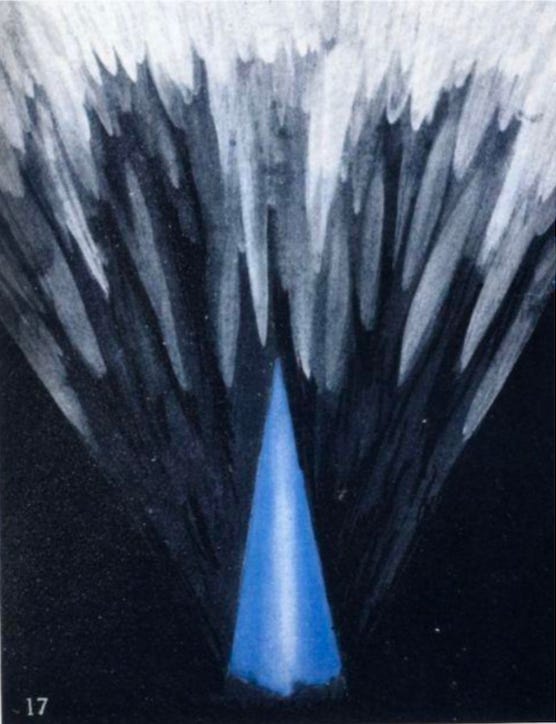
One can imagine a healthy devotional life taking the form of this image above, and so too for healthy plant life: a healthy plant that is not “dull” to the cosmos but is a true Sun-worshiper, services in total devotion to that radiant orb without hesitation, without complaint, without taking a single day off. And in so doing, it hears the song of God, the song of the universe itself. And in hearing the ballad of creation, the plant dances with it, which is the entire essence of obedience: dancing together with the music we hear. What is called “disobedience” is someone who is tone-deaf and with two left feet, stomping around on everyone else’s toes during a beautiful waltz. What is called dharma is simply everyone doing their part: the musician playing, the dancers dancing — and ideally no one stepping on anyone else’s toes. That is the same performance in the garden.
“In contrast to the content of the percept which is given to us from without, the content of thinking appears inwardly. The form in which this first makes its appearance we will call intuition. Intuition is for thinking what observation is for the percept.”37
Paradoxically, many people who would never consider themselves “intellectuals” are often the very people guilty of “intellectualism”: the inability to perceive anything except in terms of what is already familiar. What is strange is violently opposed merely because it is different, and we are too lazy to grapple with newness. For example, a materialist is a xenophobe about the populated realms of the spiritual world, even going so far as to claim such living entities “don’t exist.”
A narrow mentality brackets the newness in experiences, shoehorning them into limited categories, many of which have not been revised since childhood. What Steiner calls “intellectualism” which is really a form of bigotry, exhibiting itself as “already knowing” before any substantive experience of the new. When people say, “everyone knows” such-and-such or “apparently” so-and-so, it is invariably an imprecise claim at best. People who read and continue to study widely are forever exposing themselves to new concepts, forcing a constant renewal of their inner life through personal cultivation. So we are not to abandon the impractical scholar for the sake of the illiterate peasant, but must integrate practical life and intellectual spirituality anew.
The fact that many high school graduates in the USA never read another book marks the very bigotry Steiner warns about: present experiences being cognized exclusively in terms of the frozen past, with little openness to the newness of phenomena before us and to what they would have revealed precisely because what is diclosed in precognitive form is never as a familiar concept but first as a feeling of discomfort which modern people often avoid pathologically. The embryonic form of a revelatory idea before it is understood is a feeling of foreboding, because we do not know what it will disclose — and a single new idea born into our lives may be the end of the world as we know it:
“Surely some revelation is at hand;
Surely the Second Coming is at hand.”38
For the intellect, the spiritual world beyond truly is a kind of “outer space” in which it cannot function any more than a pig can fly. At first, only an uncomfortable, inarticulate gurgling emerges from the spiritual world. We can’t understand what we have not heard before, so we must listen for the whispered word. The celestial hierarchies do not, at first, convey meaning, but rather a sort of rumbling of feeling. If we do not have focused attention into that illimitable space, it remains little more than a sensation of discomfort. Only by staying with that discomfort does an articulate word — a new concept — communicate itself to us. But even there, people often stop short. The heard word must be spoken as lived action. It is not enough to hear the murmuring of the spiritual world, or even to hear a word or two, they must be lived out in devotional service in the external world. The koine Greek word for obedience is ὑπακοή (hypakoē) — which literally means to “hear under” but more accurately means something closer to understood. Heard. The word for disobedience is παρακοή (parakoē) — which means something close to “hearing amiss” or mishearing. Any divine message from the spiritual world that is not promptly obeyed was never truly heard.
What the epiphany of a new idea arriving discloses is not titillating information or a novelty to discuss at dinner parties; no, it is an arrival heralded by Gabriel’s trumpet. Such a revelation cannot be communicated except by action performed in silent devotion.
The great initiatic schools had as the very first rule for the initiate, “Keep Silent!” This, of course, was a bit of a rouse: to become initiated, you must be quiet enough to hear that still small voice, and once you’ve heard it, you can’t talk about it directly because it doesn’t work that way. It’s foolproof! How can you communicate what you can only receive in silence to anyone who’s jabbering on?
The spiritual world demands that your entire life, down to how you brush your teeth, must be rearranged to serve the angelic world. In India, this is called “yoga.” This is a frightful thing to everything small we cling to in ourselves. Why would we ever imagine the spiritual world is comfortable? The asuras make people feel ever more complacent, while everyone who encounters an angel trembles in holy fear. “For beauty is nothing but the beginning of terror, which we are still just able to endure, and we are so awed because it serenely disdains to annihilate us. Every angel is terrifying.”39 Worst of all, the same poet warns us, there is nowhere to hide: “for here there is no place that does not see you. You must change your life.”40
You can know for certain that an idea is not really fathomed when it does not inspire enough devotional warm initiative to live out the idea in action, to do something with it for the sake of others. To believe an idea without feeling it is important enough to live out in practical life is the complete death of spiritual life, all the while believing itself to be spiritual in its satisfaction with cursory views. Practicing daydreaming about information we care not a wit for is an exercise only in idleness.
Intuition’s disclosure of a new idea is felt in the final experience of “Eureka!” in which the new breaks into our lives, demands action, and if it is a real living understanding, it is not a matter of choice if you understand something. Most of us only notice the lightbulb going on in our heads, not the invisible influx of energy that illuminates it. Consider that: what unseen current fuels your epiphanies?
In the face of the revelatory new, we must sell all our ideological possessions and, before that singular revealing, start everything anew. “A condition of complete simplicity / (Costing not less than everything)”41 Spiritual life is enormously rich: it only asks us to give up our rags.
Alan Chadwick would describe this kind of “head” knowledge (mere information from a book) as the archetype of “the scholar,” a phenomenon we can witness in people who can read (or talk) about anything ad nauseam but can DO very little with that information. It’s not that scholars are always wrong — they may be right to an extent, but they don’t actually know when they are right because most of it remains untested by life experience. “Whoever becomes completely a scholar is completely emptied of God, and completely filled with himself.”42
People may know a lot of information and endless factoids about plants, yet lack enough genuine devotional feeling or practical discipline to keep real plants alive. How can we call anyone a real botanist who can’t keep a green plant alive?
A serious violence of our time is the absurd belief that anyone can bypass the effort of 10 years (or 10,000 hours) of practical experience to become proficient at something — to become a journeyman — whether it is a violin or a garden or anything else. Very few people have spent this much time on any one discipline. The proliferation of LLMs has spread a growing hallucination of knowledge, though what these machines produce is absolutely littered with egregious errors. In the USA in particular, people seem to believe that a bit of Googling (or ChatGPT) can give them all the information they need. Of course, most of the interesting scientific disclosures are in expensive journals that are not available to the average Googler. Imagine going to the library and absolutely no reference texts were available to you — that’s the kind of research you get by “doing your own research.” It is a bit of a stretch to imagine any of us will be experts in more than one thing by the end of our lives. There are a few exceptions, but they are not very many. A Leonardo da Vinci, or Rudolf Steiner, perhaps, but none of us is either of them. Surfing the web never does more than skim across the surface of reported reality, but it never plumbs the depths of the ocean of knowledge, which can only be found through experience. To be chronically online is to remain only on the outermost surfaces of things.
We see the sheer hubris of dead “head” knowledge when governmental agencies regulate fields of life, such as agriculture, and yet the people writing the laws have no experience rehabilitating fields or even ever farming. You can have people seeking to “fix” areas of life in which they have no experience. Imagine your accountant trying to perform open-heart surgery.
Particularly in my experience in the USA, people don’t seem to want to admit that there are always people who know a lot more than they do. This is true in biodynamics and in every other field. As I’ve farmed and had many apprentices, I initially had more naïve ideas about consensus and “flat” organizational structures, but the longer I farmed, the more I realized there is an inviolable hierarchy of experience. This is not a hierarchy of force or patriarchy, but a real spiritual hierarchy that often hides in the lowest positions of society.
This is why we should respect elders: they have more experience than us. Whether they gleaned the right lessons from their experiences — and whether they were paying attention is quite another question, but the only people who believe there are no experts are those who have not gained any significant expertise themselves. Anyone who has gained a modicum of wisdom in their field becomes proportionally humbler about other fields because they know: “Wow, my small portion of practical knowledge was sure hard to come by, imagine how difficult yet another subject is to master!”
The only answer is to turn back to the Queen of Nature. To sit with a plant so long it becomes boring, and yet keep studying its contours, and even when it seems futile, to do it again. And again. Until this becomes your default mode of existence. The revelations of nitrogen will arrive at surprise moments, and not when you’d like them to show up — particularly not merely when you’re trying to squeeze something out of the plant.
Chadwick bemoaned that today “everyone is a scholar.”43 Which is to say, everything is up in our heads, and we have very few skills we can put into practice with our hands.
Just as the task of biodynamic agriculture is to revivify dead soil, so, as individuals, it is our task today to enliven the abstract scientific mentality with the pixiedust of practical experience. Rudolf Steiner himself said that, “Among the many things I should have done in this present incarnation, but did not find it possible to do, was this. When I was a young man, I had the idea to write a kind of ‘peasant’s philosophy,’ setting down the conceptual life of the peasants in all the things that touch their lives.”44 I might argue that the fact that Steiner deferred his own personal destiny to perform this task and instead diverted his energies to fulfilling the failed task of another to edit Goethe’s scientific work, that the conscious suppression of his personal desires gave unusually vitalizing force to the imaginations Steiner imparted as biodynamics through his 1924 Agriculture Course. Which is to say that, in a way, he still did write a kind of “peasant’s philosophy” after all. If you are reading this, you may well know what I mean.
The rural “peasant” growing food — however unread he seemed to be — always studied Nature through experience and experiment out of pure necessity and often knows far better the nuances of growing specific crops in a given region than a university agriculturalist with a plastic plant on their office desk in the city who may not have walked on grass the entire last year.
“We shall not cease from exploration, and the end of all our exploring will be to arrive where we started and know the place for the first time.”45
Rudolf Steiner, Theosophy: An Introduction to the Supersensible Knowledge of the World and the Destination of Man, GA 9, Chapter IV, “The Path of Knowledge.”
Glenn Clark, The Man Who Talks With the Flowers: The Intimate Life Story of Dr. George Washington Carver. St. Paul, Minnesota: Macalester Park Publishing Co., 1939.
No books are ever brought in here.” Glenn Clark, The Man Who Talks With the Flowers, originally published in 1939, chapter I.
Rudolf Steiner, Theosophy: An Introduction to the Supersensible Knowledge of the World and the Destination of Man, GA 9, Chapter III, section 6, “Thought Forms and the Human Aura.”
Of course, this requires a specific state of mind to be receptive to anything more than one’s own habitual associations with particular colors.
Rilke, Go to the Limits of Your Longing
There are exceptions, and once someone is proficient (after 10,000 hours or 10 years of a particular activity), this is no longer the case for them because such work has become a flow state — “concentration without effort.” Such people seem to do two things at once because one task has matured to the point that they can perform it on autopilot. But even here, one’s attention can never be on two things.
Henry David Thoreau, Journal, February 23, 1860.
Rudolf Steiner, Agriculture Course, GA 327, Lecture V, Koberwitz, 13 June 1924
Simone Weil 13 April 1942
Shams of Tabriz, Rumi’s Sun, 339.
Friedrich Nietzsche, Beyond Good and Evil: Prelude to a Philosophy of the Future / Jenseits von Gut und Böse, Part IV, “Maxims and Interludes,” §146.
St. John of the Cross, Ascent of Mt. Carmel, 2.1.(3).
Thomas Aquinas, reported by Reginald of Piperno in the Naples canonization process, Processus canonizationis Neapoli, LXXIX, in Fontes vitae S. Thomae Aquinatis: notis historicis et criticis illustrati, ed. Dominic Prümmer (Toulouse: Privat, 1911), 377: “Omnia que scripsi videntur michi palee respectu eorum que vidi et revelata sunt michi.”
1 Corinthians 8:1
Rudolf Steiner, The Way of Initiation; or, How to Attain Knowledge of the Higher Worlds, trans. Max Gysi (New York and London: G. P. Putnam’s Sons, 1908), 100; German original in Wie erlangt man Erkenntnisse der höheren Welten?, GA 10.
Steiner, Rudolf. “The Karma Question and the Hierarchies.” Dornach, 17 February 1924. Lecture 2 in Esoteric Considerations of Karmic Connections, Volume 1, GA 235. Translated by George Adams.
GA 327, Lecture IV, Koberwitz, June 12, 1924
Steiner, Rudolf. “Lecture II.” In The Kingdom of Childhood, GA 311. Lecture given at Torquay, August 13, 1924. London: Rudolf Steiner Press, 1982.
Alan Chadwick, “Fertility and The Merchant and the Seer,” Covelo Village Garden, Covelo, CA, September 11, 1975. Archive ID CA1050.
Maathai, Wangari. “Speech at Goldman Awards.” San Francisco, April 24, 2006
Wade-Giles: Chuang Tzŭ, ch. 13; Wheelwright Pien and Duke Hwan.
Alan Chadwick, Performance in the Garden: A Collection of Talks on Biodynamic French Intensive Horticulture, edited by Stephen J. Crimi, Logosophia Press, 2007, 342 pp., ISBN 9780981575704.
Chadwick, Alan, quoted in Stephen J. Crimi, “Entrée to Alan Chadwick’s Garden of the Future,” in Alan Chadwick, Performance in the Garden: A Collection of Talks on Biodynamic French Intensive Horticulture, ed. Stephen J. Crimi (Mars Hill, NC: Logosophia Press, 2007)
Steiner, Rudolf. “Lecture V.” In The Younger Generation: Educational and Spiritual Impulses for Life in the Twentieth Century, GA 217. Lecture given at Dornach, October 7, 1922. London: Anthroposophical Publishing Company, 1967.
Rudolf Steiner, “Developing Honesty in Thinking,” lecture of July 7, 1923, Dornach, in Learning to See in the Spiritual World, GA 350. Published in English by Anthroposophic Press, 1990.
Tamas seeks immediate pleasure, which is nostalgia. Rajas seeks seductive acquisition. Sattva defers pleasure out of fear for long-term (“karmic”) consequences (e.g, the fear of God is the beginning of wisdom). These are the three gunas articulated in Vedanta. As Richard Rose puts it: “One of the moods is Fear. Another is Seduction or acquisition. And the third is Nostalgia.” Rose, Richard. “Lecture on Moods.” In The Direct-Mind Experience: Lectures, 32–41. Benwood, WV: TAT Book Service, 1985. To be clear, these are chiefly for self-diagnosis, not condemnation of others, though you may justifiably avoid people who embody the worst of these elements because association with them is rarely fruitful.
The Buddha. Dhammapada, verse 76, Paṇḍitavagga / “The Wise,” Khuddaka Nikāya. Translated from the Pāli by Acharya Buddharakkhita, in The Dhammapada: The Buddha’s Path of Wisdom. Buddhist Publication Society, 1985.
Goethe, Johann Wolfgang von (1995). Scientific Studies (vol. 12 in Goethe: The Collected Works), edited and translated by Douglas Miller Princeton NJ: Princeton University Press, pg. 39
Steiner, Rudolf. “The Three Worlds and Their Reflected Images.” Lecture given in Torquay, August 12, 1924. In True and False Paths in Spiritual Investigation, GA 243.
Matthew 26:40
Owen Barfield, Night Operation (UK: Barfield Press, 2008), 50.
Hölderlin, Patmos.
The folk etymology of the Sanskrit asura makes it an antonym of sura, a “heavenly being” (or angel). An a-sura, then, is a “hellish being” (or demon) filled to the brim with unfree habits.
Rudolf Steiner, The Deed of Christ and the Opposing Spiritual Powers GA 107, 22 March 1909, Berlin
Chapter 16, verse 7
R. Steiner, Philosophy of Freedom
William Butler Yeats, The Second Coming
Rilke, Duino Elegies
Rilke, Archaic Torso of Apollo
T.S. Eliot, The Four Quartets
Shams of Tabriz, Rumi’s Sun, 336.
Alan Chadwick, “Garden Song – Interview Outtakes (1979),” filmed outside New Market, Virginia, by John deGraaf and Jim Mulligan for the PBS documentary Garden Song.
R. Steiner, Agriculture Course
T.S. Eliot, The Four Quartets
I am about to print this so as to give it the pondering I know it richly deserves. Also I tried to respond at the note where you tagged me, but I am so Substack-stupid I couldn't figure out how. (Everytime I clicked on the note it took me to my dashboard!) Responses coming by a different channel than Substack . . .